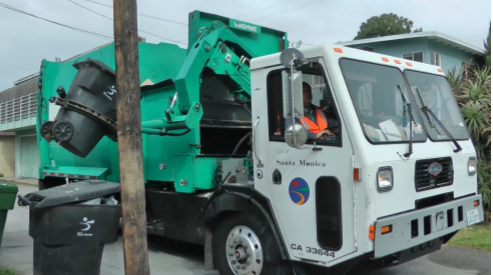
R3 conducted a comprehensive review of Santa Monica’s waste collection and recycling operations to help the city improve efficiency, maintain fair rates, and advance toward its ambitious zero waste goals. Our team analyzed how the City’s Resource Recovery and Recycling Division operated—from staffing levels and equipment to service routes and customer interactions. Through detailed interviews with City staff and residents, we identified opportunities to enhance productivity, safety, and long-term sustainability while ensuring the division had the resources needed to serve the community effectively over the next decade.

A critical part of our work involved protecting ratepayers by examining the City’s billing systems and rate structures. We audited billing records to verify accuracy and compared Santa Monica’s customer billing technology to industry standards used by private haulers. Since the City used systems not specifically designed for solid waste collection, we evaluated whether upgrades could improve service and reduce errors that affect residents. We also conducted a detailed rate study to confirm that current fees covered actual costs and developed a 10-year financial model that allows the City to plan for capital investments, operational changes, and new programs without unexpected rate increases.

Our analysis directly supported Santa Monica’s Zero Waste goals by identifying the most cost-effective strategies to increase diversion from landfills. We evaluated current programs and recommended new initiatives that would move the city closer to achieving 95% waste diversion by 2030. This included assessing opportunities for enhanced recycling, organics processing, and community engagement. We compared how other comparable communities managed the financial impacts of ambitious environmental programs, giving Santa Monica proven strategies that balanced environmental leadership with fiscal responsibility.

Throughout this engagement, we facilitated robust community outreach to ensure residents understood how waste services were funded and what changes might be coming. We developed materials for the Zero Waste Plan and Rate Study that translated complex technical and financial information into plain language. Our goal was to provide Santa Monica with clear options and recommendations that served both the City’s environmental vision and its residents’ need for reliable, affordable waste services. By taking a data-driven approach, we helped the City make informed decisions that would improve operations, achieve ambitious diversion targets, and maintain public trust in how ratepayer dollars are used.

MTWS Performance Review for Los Altos - Project Analysts Claire Wilson and Ryan Calkins

Performance Review

R3 was engaged by the City of Los Altos (City) to conduct a Performance and Billing Review of Mission Trail Waste Solutions (MTWS) as included under their Collections Service Agreement (Agreement) to provide solid waste, recycling, and organic collection services for the City. R3’s high level review of MTWS consisted of two main tasks: a performance review and a financial compliance assessment. The primary goal was to determine MTWS’ compliance with the applicable terms and conditions of the Agreement, review the effectiveness of current operations; and identify opportunities for program improvement.

R3 worked with MTWS management and City staff to assess MTWS’ compliance with the reporting requirements and performance standards of the Agreement, as well as verify customer billing rate calculations and service levels, franchise fee calculations, and reported diversion percentages.

R3 utilized a variety of methods in the execution of the performance review, including analysis of relevant documents, on-site and field observations, and interviews. The Performance Review addressed the following major aspects of MTWS’s operations:

  • Collection Service Agreement Compliance Review;
  • Collection Operations Review;
  • Management and Administration Review;
  • Vehicle and Equipment Maintenance, Repair and Replacement Review;
  • Customer Service Review (including customer feedback);
  • Monthly, quarterly and annual report assessment;
  • Diversion Programs, Performances and Good Faith Efforts; and
  • Outreach and Education Services.

R3 conducted the financial compliance assessment to determine that customers are being charged the proper service rate based on their service level; service rate revenues are properly recorded and accounted for by the contractor; franchise fees are properly calculated, paid and received. R3 conducted three tests to accomplish this goal:

  • Test of Subscribers to verify that service subscribers are billed the correct rate for the level of service provided;
  • Test of Revenue Transactions to verify that the billed amounts to City residents and businesses, and the corresponding payments received are properly recorded in the MTWS billing and accounting systems; and
  • Test of Franchise Fee Transactions to verify that the franchise fees are calculated correctly, and based on the correct level of recorded revenues.

Our review found that MTWS is in compliance with the vast majority of the Agreement’s requirements. Collections are performed in a safe, courteous, and cleanly manner; coordination between the drivers, customer service, shop, and management is facilitated by an effective system of work orders; fleet maintenance operations and vehicles have consistently received satisfactory ratings from the California Highway Patrol; and MTWS is operating a sophisticated and professional customer service operation.

We determined that the most significant area for improvement relative to the Agreement’s terms and conditions is in outreach and education, which is not being performed according to the Agreement’s requirements.

Project benefits include:

  • Verification of MTWS’ compliance with the vast majority of the Agreement’s provisions;
  • Recommendations for MTWS’ improved compliance with the existing requirements of the Agreement regarding meeting reporting requirements, outreach and education activities, and paying the City franchise fee and administrative fees; and
  • Recommendations for revisions to the Agreement with regards to HHW collection services, rate requirements, and the billing schedule.

High Diversion Planning

R3 has been working with the City of Los Altos (City) since 2010, when we were originally engaged to provide procurement assistance resulting in the award of the Franchise Agreement (Agreement) with the City’s current hauler, Mission Trail Waste Systems (MTWS), that requires 78% diversion of franchised waste.

In service of our ongoing diversion support for the City, R3 has recently:

  • Completely revised the City’s Solid Waste Ordinance to align with the Agreement with MTWS, facilitated complete subscriber compliance with two State of California Assembly Bills (AB), AB 341 (mandatory multi-family and commercial recycling) and AB 1826 (mandatory commercial organics diversion), and facilitated increased diversion of recyclables and organics from commercial, industrial, and multi-family waste generators;
  • Undertaken an SB 1383 preparedness exercise in which we identified opportunities for the City to obtain needed support from MTWS in complying with the regulations;
  • Assisted the City in identifying enforcement thresholds for mandatory recycling and organics service: drafting enforcement letters which include notification of state law for generators covered under AB 341 and AB 1826, exemption forms, and a self-haul tonnage reporting form; and site visits to covered generators to encourage compliance;
  • Reviewed implementation of services in the field, including lid-flip assessments of waste from the top 50 generators in the City, as well as an assessment of MTWS’s outreach and education pertaining to increased diversion of recyclables and organics;
  • Developed a technical assistance plan and framework in support of the City’s commitment to providing diversion-related technical assistance and outreach;
  • Revised the City’s Construction and Demolition (C&D) Debris ordinance in alignment with CALGreen, establishing a system of facility certification;
  • Certified facilities and revised the City’s mandatory building checklist to include the certified facilities and other approved means of compliance such as deconstruction and purchase of a debris box from the City’s franchised hauler;
  • Conducted a street maintenance impact fee study for refuse vehicles used in the City; and
  • Completed the City’s Electronic Annual Report to CalRecycle for the reporting years 2016-2019.

R3 has also been engaged to assist the City with contract extension negotiations with MTWS, which includes support for some SB 1383 requirements, including universal roll-out of organics service to all businesses in the City.
 

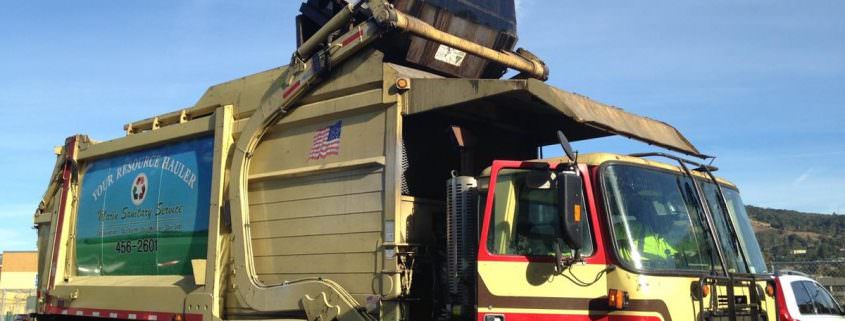
In 2017, R3 conducted a comprehensive rate methodology review for the Marin Franchisors’ Group (Group)—a coalition of jurisdictions including the Cities of Larkspur and San Rafael, the Town of Ross, the County of Marin, and Las Gallinas Valley Sanitary District. When the recycling market collapsed, the Group faced over $1.15 million in accumulated losses that threatened service stability across all member communities. We worked closely with the Group and their franchised hauler, Marin Sanitary Service, to develop a sustainable rate methodology that protected ratepayers while ensuring the continued viability of recycling programs. Our team simplified and streamlined the existing rate adjustment process, creating a clearer system that addressed both routine cost changes and extraordinary circumstances like recycling market fluctuations.

We developed new methodologies that fairly allocated recycling costs and revenues across different communities while addressing the challenge of commercial customers migrating to lower-cost service areas. By establishing performance metrics and tracking mechanisms, we gave the Group better tools to understand service outcomes and make data-driven decisions. We also revised the overall rate-setting process to achieve greater simplification and stability, making it easier for residents and businesses to understand how their rates were calculated. This included instituting formal succession planning to ensure continuity as leadership changed over time.

Since that initial engagement, R3 has been retained annually to provide ongoing rate review services for the Group. Each year, we conduct detailed cost-based rate analysis to ensure fees remain aligned with actual expenses and market conditions. For example, in 2018, we determined an overall rate increase of 9.58% was necessary to cover projected expenses and address the recycling market crisis, helping the Group make difficult but necessary adjustments to keep waste collection and recycling services financially sustainable. This annual partnership ensures the Group’s rate methodology remains responsive to changing conditions while protecting ratepayers from unnecessary increases. Our continued involvement helps these  communities maintain reliable waste services and meet California’s environmental goals without compromising fiscal responsibility.

R3 Consulting Group Now Offers:

Disaster Debris Management Planning Assistance to California Cities

No one is ever completely ready to handle a natural disaster, but with our help, you can avoid spending unnecessary funds, resources and time in the event of a disaster. We specialize in creating disaster debris management plans that are unique to your community, meaning you’ll have a plan in place when you need it most. Not only that, but municipalities with disaster debris management plans will be prepared in the event of a disaster, meaning time and energy are maximized, along with potential for FEMA reimbursement if protocols are followed. Let us help you navigate through the complicated process of disaster debris planning and make sure your FEMA reimbursement dollars are maximized.

Last month FEMA extended its Alternative Procedures Pilot Program which allows for up to an extra 2% of federal cost share reimbursement on money spent.  The opportunity to participate in this pilot program will be available through June 2018.  There is no better time than now to start planning.

Once we complete your plan and it is reviewed by FEMA for this program, the municipality will be eligible for this additional 2% reimbursement – money that you would have otherwise been spent out of pocket if no plan was in place.

Our plans are:

  • CalOES Approved
  • FEMA Approved
  • Guaranteed to participate in the Public Assistance Alternative Procedures Pilot Program (time dependent)

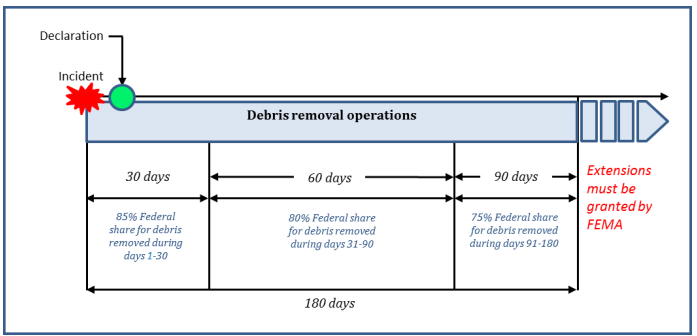
FEMA timeline of disaster reimbursement

(Above: FEMA timeline of disaster reimbursement)

More About Our Process

We will consider:

  • The type of disaster(s) that may potentially occur in your community
  • Your staffing levels and who would play certain roles when a disaster occurs
  • Your opportunities for procuring various contracted disaster debris management services
  • Potential sites in your limits that could be used for temporary debris removal and storage
  • Public information examples

Our process includes:

  1. Meeting with you to obtain base level data and confirm expectations of our services
  2. Providing the jurisdiction with a Draft 1 disaster debris management plan (DDMP)
  3. Reviewing the draft DDMP with the jurisdiction
  4. Providing the draft to CalOES, who will review the plan for completeness
  5. Revising the draft based on CalOES comment and provide a new draft to CalOES (this may take multiple iterations)

CalOES will forward the draft plan to FEMA once it has approved the plan. Once FEMA has approved the plan, you’re all set!

DDMPs are essential for:

  • Saving time and money
  • Having a quick and effective response to and preparation for a disaster
  • More efficient use of limited resources, including staff time

“Congratulations – that was an awesome plan. It was the best one I’ve ever reviewed.”   – Melinda Stehr, CalOES

R3 assisted the City of Piedmont with franchise extension negotiations with the City’s hauler, Republic Services (Republic). During negotiations, Republic requested unacceptable rate increases, and R3 subsequently recommended going to bid.

R3 subsequently conducted a competitive process to procure high-quality services for garbage, green waste, and recyclables collection and processing and also conducted an operations and billing review of the City’s franchised hauler, Republic.  Among other tasks, R3 conducted a survey of rates and services for comparative communities, fully reviewed the current Agreement, established a set of recommendations for the new Agreement, and organized the City’s “deal points” for potential inclusion in an extended and restated Agreement.

City Council approved staff’s recommendation to proceed to negotiations with Republic, and R3 scheduled negotiation meetings and submitted letters to Republic for clarification of their proposal and stances on various negotiation items. The second round of negotiations resulted in Republic being selected for the solid waste collections contract.

As a result of our negotiation assistance, the City gained the following benefits:

  • The provision of on-premises “backyard” service at a surcharge equivalent to the costs of providing these services, except for physically disabled residents, who pay curbside rates;
  • A new fleet of collection vehicles;
  • Compact fluorescent lamp (CFL) pickup at curbside;
  • Payment to the city of $75,000 (escalated by CPI) per year to fund the provision of commercial education and outreach services by the City or its representative; and
  • Bulky item pickup provided twice per year for up to 6 cubic yards per event for single-family residents and provided to multi-family residents at the request of the property manager.

Using our combined experience developing high diversion franchise agreements, designing state-of-the-art, community-based social marketing and outreach methods, and evaluating the effectiveness of solid waste diversion programs throughout California, R3 collaborated with our subconsultant, Cascadia, to prepare the Phase 2 Strategic Plan for High Diversion for the City of Livermore (City). R3’s project approach moved beyond eliminating barriers to diversion by incentivizing achievement of high diversion goals for all parties, including solid waste haulers, processors, and generators. Phase 2 built upon the City’s prior success by enhancing current generator-focused programs and requiring haulers of solid waste to share in both the responsibility and reward for diverting waste from landfills. High diversion program options were assessed based on what would cost effectively divert the most tons from disposal.

Through observation of select diversion programs in the field, interviews with the City, LSI, StopWaste and select waste generators, as well as review of detailed tonnage reports and subscription levels, R3 developed a high-level baseline analysis to measure the effectiveness of current diversion programs. Building on this analysis, R3 developed a recommended set of programs with the greatest potential of diverting waste from landfills during – and beyond – the five-year planning horizon. R3 created a set of recommendations that focus on ways in which the City can enhance the effectiveness of current programs, as well as develop new programs to cost-effectively increase diversion for the City.

Additionally, R3 estimated the amount of additional diversion that could be realized by each of the recommended new programs and estimated the cost for each program and the cost per ton that each program will divert. R3 also performed a high-level evaluation of the relationship between LSI’s rate structure and successful diversion behaviors.

Project benefits the City gained include the following:

  • Identification of opportunities to encourage and reward achievement of high diversion goals for all stakeholders;
  • Strategic planning for higher diversion grounded in a data-driven approach;
  • Pursuit of diversion opportunities that most effectively move tons out of landfills per dollar spent; and
  • Responsibility and reward for diverting waste from landfills is shared between the City and its franchised waste hauler.

R3 provided negotiation services to the City of Berkeley, who was seeking to arrange for the recyclables processing services currently provided by Community Conservation Centers (CCC). R3 provided support in the negotiation of a short-term contract with CCC to continue to provide recycling processing services as the City begins redevelopment of one of its solid waste facilities and the development of long-term solid waste policies via a Zero Waste Plan.  R3’s objective was to facilitate a contract that provides the City with a greater level of operational and financial accountability from CSS and resolves outstanding matters of dispute, including amounts owed to the City by CCC per the terms of the current contract.

For this engagement, R3 conducted the following main tasks:

  • Established clear objectives and refine initial positions with respect to the City’s key interests and desired outcomes from these negotiations;
  • Updated analysis of recyclables market conditions to provide the City with detailed cost estimates of hauling/processing recyclable materials at other facilities;
  • Led negotiation sessions with the City and CCC over the course of three half day negotiations;
  • Attended meetings with City staff, prepared negotiation session agendas, and attended negotiation sessions (phone and in-person);
  • Reviewed and analyzed cost and program data presented by CCC and made recommendations to City staff;
  • Drafted a new recyclables processing agreement for review by the City and CCC;
  • Facilitated five (5) rounds of revision and comment by the City and CCC; and
  • Assisted City staff in the preparation of a staff report to the Council presenting the results of these contract negotiations.

As a result of R3’s assistance, the City gained the following benefits:

  • Excel workbook of recyclables market conditions estimating hauling/processing costs for three alternative recyclables processing facilities;
  • Negotiation and finalization of a short-term contract between the City and CCC that clearly addressed CCC’s operational and financial accountability;
  • Creation of a compensation structure that takes into account revenues lost from the impacts from China’s National Sword while providing assurances for the City that its hauler will be able to collect and market materials;
  • Resolution of the amounts owed by CCC to the City per the contract (~$800,000);
  • Cessation of CCC’s periodic requests for special payments from the City, which had been made outside the terms of the current agreement; and
  • The creation of a coterminous Agreement with the City’s Agreement with Ecology Center for the City to make an educated decision of the future of its Agreements.

In early 2016, R3 was engaged by the City of Rolling Hills Estates (City) to conduct a Performance Review of their franchised hauler, Waste Management (WM), with the objective of assessing WM’s collection operations prior to the Franchise Agreement’s (Agreement) expiration.

Overall, WM received a positive review, although R3 found that they were out of compliance on vehicle weights and diversion standards, and they were substantially undercharging for manure collection and processing, which in turn negatively impacted their other required services.

Rather than seeking competitive bids, the City opted to work with the hauler to correct the compliance violations and renegotiate the contract, because of the City’s unique service requirements (e.g., unlimited multiple container sizes for recycling and organics at no cost; required use of smaller collection trucks; and required no-cost service for hard-to-service areas). R3 subsequently worked on the City’s behalf to negotiate the new Agreement, which assists the City in complying with state legislation (e.g., AB 939, AB 341, AB 1826, and AB 1594), prevents negative impacts on customer rates, and includes these beneficial features: a very specific public education program; a contamination monitoring and reporting program; and universal rollout of organics to all commercial and multi-family customers as a base service requirement.

R3 is currently assisting the City with modernizing and streamlining the language in the City’s municipal code to include legislative requirements for recycling and organics diversion (AB 341, AB 1826, SB 1383, and AB 1594).

R3 was engaged by the City of Half Moon Bay to provide full service assistance with the City’s procurement of solid waste collection and street sweeping services. The City identified the following goals, among others, which R3 addressed as part of the RFP process:

  • Improving the quality of contractor reporting content, including tracking of special events and public education activities undertaken by the contractor;
  • Considering the possibility of new customer rate structures;
  • Potentially implementing a “Vehicle Impact Fee” to recover the cost of street deterioration caused by collection operations;
  • Exploring new programs such as residential organics, and expanded commercial organics collection, and including applicable program requirements as part of the RFP process;
  • Considering street sweeping schedule changes to meet the requirements of new storm water plans.

R3’s procurement assistance services for the City included:

  • Reviewing City and current contractor resource documents, working with stakeholders, and compiling the RFP package;
  • Developing collection program requirements, the franchise agreement, minimum contractor qualifications, and a mailing list of potential proposers;
  • Preparing evaluation criteria, providing written responses to questions submitted regarding the RFP, and preparing addenda as necessary;
  • Conducting the pre-proposal meeting, evaluating responses, conducting interviews, and checking references of proposers;
  • Attending City Council meetings, assisting with the presentation of the results of the evaluation process and staff recommendations, and finalizing the franchise agreement.

As a result of R3’s assistance, the City gained the following at the conclusion of the procurement process:

  • A dedicated recycling specialist;
  • Food waste collection and processing for all customers;
  • Two HHW drop-off collection events for the City; and
  • An implementation plan designed to lay out the foundation for new services and facilitate a smooth transition before the start of the new contract.


In 2004, the City of Stockton entered into a franchise agreement with two waste haulers, Republic Services (previously Allied Waste), and Waste Management (USA Waste), the number #1 and #2 largest solid waste management operators in the Country. The 15‐year agreement provides a residential and commercial 3‐cart waste collection system that includes recyclables, green and food waste. The franchise agreement with both haulers is due to expire in 2019, unless it is extended. Read more